Systems · Societal/ Cultural · Specific
Dwarven Calendar
How does a culture measure time underground, without any sun? The dwarves have got it covered.
 Legacy quest
Quest - Summer Doldrums
This time of year often brings the summer doldrums to the Citadel. A time of slow updates and intermittent submissions. We may have passed the worst but until the summer ends, the weather changes and school starts again … Open the quest
Full quest brief
This time of year often brings the summer doldrums to the Citadel. A time of slow updates and intermittent submissions. We may have passed the worst but until the summer ends, the weather changes and school starts again we may not have the action we sometimes have.
Because of that, we are holding the Doldrum Quest. I wanted it to be pretty open to most anything so we will attach it to the Guild quests again to allow people to branch out how they want. This also adds some incentive to join and progress in the Guilds. So go join a Guild now and if your submission goes towards your Guild accomplishments, it can go towards this quest as well.
Get us clear of the Summer Doldrums by joining the quest!
Runes
The importance of runes in dwarven culture, cannot be overestimated. Runes are simply put; carved symbols, similar to an alphabet. Runes exist in two varieties, the common everyday runes, that anyone can carve. And the sacred runes, that only runepriests can create, that are used in imbuing power in weapons and tools. This process is also known as enchantment, but dwarves are very particular to point out that there is a world of difference between fickle and untrustworthy magic, and runes. Though obviously most magi would disagree, as noone can find much differences between the two, other than visually.
In total, there are 24 mundane runes, called Futhark. Each rune has several meanings, all depending on which other runes they are paired up with and context. Only a runepriest could tell you how many sacred runes there are, but would most likely not be willing to.
Background
The dwarven word for hour, is the same as their word for Geyser, the very similar Geysir. The reason for this, is that is how the subterranean dwarfs tell time. Once every hour, without fault, the ancient geyser of madroszal erupts. Madroszal is the dwarven name for the giant cavern known as the mother hall, where the dwarven capital, Khazad-Madros, their very first city-state, lies.
Any other subterranean dwarven settlement all have at least one geyser that erupts roughly at the same time as the gesyer in the mother halls. Since travel is hard in the Underdark, these unofficial time-zones usually aren't noticeable. Especially so since there are places in the Underdark where rumours suggest that time itself is warped.
The reason why their days are 72 hours long, is lost in time. But there are plenty of theories, one being that 72 is the number of times an average heart beats in one minute. But most would just credit it to the dwarven spirit, and their love for hard work. It's certainly something the dwarves themselves like to brag about.
The Cycles
60 seconds = 1 minute (Same as ours)
60 minutes = 1 hour (Same as ours)
1 hour = 1 Geysir (Same as ours)
Second = Oko (oh-koh)
Minute = Chwila (ch-weela)
Cycle = Cztenec (ytch-ten-eck)
Tydzien Cztenec (tid-jing) = Week, comes from the word small.
Duzy Cztenec (du-tche) = Month, comes from the word big.
Ogro Cztenec (oh-groh) = Year, comes from the word huge.
72 Geysir = 1 Dwarven day and night
(56 hours awake, 16 hours asleep)
-
The 72 hour period is known as a 'ief'. Which could be translated into life, strife, work or fun.
The 56 hour period is known as a wakening, or 'budzic'.
The 16 hour period is known as a short death, blink, long break, or 'mrok'. This pertains to the sleep, if you're awake, it's known as 'noc'.
In the middle of the 56 hour period (after 27 hours), there is a two hour siesta, known as a 'brekka'.
It is worth noting that not all dwarves follow this schedule at the same time. Like in every major city, there needs to be night-time workers, but since there is no sunlight underground, the dwarves have taken this to the extreme. A dwarven city never truly sleeps, when one half wakes up, the other goes to bed.
There are 24 mundane runes, and time is kept by the use of two rune cycles.
The runes are (from left to right):
|
Fehu (f) |
Uruz (u) |
Turisaz (th) |
Ansuz (a) |
|
Raido (r) |
Kano (k) |
Gebo (g) |
Wunjo (w,v) |
|
Hagalaz (h) |
Nauthiz (n) |
Isa (i) |
Jera (j,y) |
|
Eihwaz (ae) |
Perth (p) |
Algiz (z) |
Sowelu (s) |
|
Teiwaz (t) |
Berkana (b) |
Ehwaz (e) |
Mannaz (m) |
|
Laguz (l) |
Inguz (ng) |
Othila (o) |
Dagaz (d) |
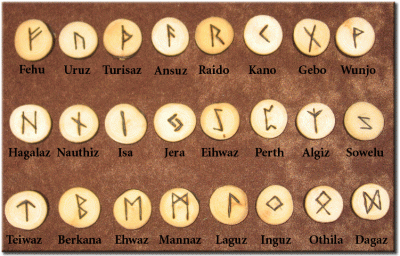
A year starts with Fehu Fehu, and ends after Dagaz Dagaz.
The first rune, is the big cycle. The big cycle turns 24 times in 1 dwarven year, and represents the months. On the 25th turn, a new year begins.
The second rune, is the small cycle. The small cycle turns 24 times, before the big cycle turns once.
The small cycle represents the weeks, each week has 24 ief (days and nights).
So it goes; Fehu Fehu > Fehu Uruz > Fehu Turisaz >>> Fehu Dagaz > Uruz Fehu, and so on.
24 ief (days and nights) after Dagaz Dagaz, a new year begins.
In order to keep track of the years, they count the cycles, which in itself is a third cycle, that takes 13,824 ief to turn. So a dwarven year could read something like, the 7th cycle of the 3,063rd Fehu Uruz.
1 Dwarven month = 24 weeks
1 Dwarven year = 576 ief
But how does a dwarven year measure up to our gregorian year? Well, (576/365)x3 is roughly 4,7.
(24x3=72).
So for each dwarven year, almost 5 gregorian years pass. Which means that a dwarf claiming to be a 100 years old, is really closer to 470.
So if you're using this calendar from a dwarf's point of view, just multiply their age with 4.7, and if your system takes into account middle age, old age etc, just divide their age with 4.7 for those values.
Notable Dates
The 1st Cycle of the 1st Fehu Fehu, the founding year of Khazad-Madros, when dwarves became dwarves.
The 18th Cycle of the 3,263rd Ansuz Nauthiz, present day. (Which in gregorian years translate into approximately year 370,650).
Every Cycle of Dagaz Dagaz, on the 12th Ief (day), which is the traditional Sinter Enmaas, or Candle Fest as it is more commonly known.
Every Cycle of Dagaz Dagaz, on the 24th Ief (day), which is New Year's Eve, or Nema Rok.
Enclaves
The day and night cycles of dwarves aren't very practical for other less industrious beings. This of course, could cause unneccesary friction with surface traders or when dealing with diplomatic envoys. To help prevent this, dwarven enclaves are often built in nearby friendly settlements. These contingents are made up of a mix of merchants, diplomats and warriors, who adapt themselves to the pace of the settlement in question.
These enclaves are not to be confused with ordinary dwarves who have just emmigrated and formed a miniature community. An enclave holds all the authority of the dwarven city-state which owns it. Though surface enclaves are often filled with caste-less dwarves, similar to most immigrants, in that few self-respecting traditional dwarves would ever venture to the endless void above, unless they're not given a choice.
When it comes to setting prices for goods, the enclaves usually tend to work together with the settlement's council, elders or local ruler, so as to not breed resentment and drive the competition out of business. Good relations are usually prioritized. But of course this goes the other way as well, if prices are allowed to run rampant and threaten the profits in the long run, that settlement might find themselves without an enclave, and cut off from any exotic dwarven goods, for a couple of hundreds of years or so, long enough for any dissidents to have died out.
Effects
The few surface dwellers who have ventured down into the depths to meet with dwarves on their own terms, have often come to regret it. Simply because what is considered a brief assembly by dwarven standards, could very well drag on for well over 12 hours. Hardly surprising, seeing as dwarves are often credited for inventing bureaucracy. And when dwarves want to be official, they tend to sit on hard cold seats.
It also tends to be hard to synch up your schedules with people down in the depths when visiting. This doesn't neccesarily mean that shops are closed, just that another shopkeeper may have started their shift, the next time you visit.
Since their days are so long, they also partake in several more meals.
Maga (ma-gah) - Meal
Rano-Maga (rano) - First Breakfast
Zjadac-Maga (tcha-dac) - Second Breakfast
Przekaska-Maga (pch-kon-ska) - First Lunch
Kaska-Maga (kon-ska) - Second Lunch
Karr-Maga (karr) - First Dinner
Mier-Maga (mierr) - Second Dinner
Przezworny-Maga (pch-zworny) - First Evening Repast
Zworny-Maga (zworny) - Second Evening Repast
Noc-Maga (knoc) - Night Time Snack
Game Mechanics
In some systems you have daily powers and rituals with time related rules, this could obviously cause a problem seeing as a day on the surface won't be the same for the dwarves. I would say that primarily, a day game mechanics wise is what we as the players define it as, which is 12-24 hours depending on how you run things. Unless of course the whole campaign takes place underground with nothing but dwarves using my calendar. If you have a mix of surface people and dwarves fresh from below though, I would suggest maybe a transition period, say 1-2 dwarven days on the surface until they synch up with everyone else, and perhaps the opposite if the adventure takes place below, though be advised that this could likely make things much harder, depending on how the game is run.
Notes
There are many other ways of measuring time underground. For instance, the lunar cycles would still affect bodies of water, even in those imagined depths. You could have water clocks, measure how far a stalactite or stalagmite grows within a certain period of time to name a few.
A huge thanks to MysticMoon, valadaar, Chaosmark and Strolen for helping me with the math.
Scrolls
Twists, chapters, and details meant to stream with the submission — not general discussion.
No scrolls yet — leave one if you have a twist worth keeping.
Sign in to plant an idea scroll.
Enjoyed this? Sign in and cross blades for Gossamer — five clashes, up to 25 XP.
Sign in to cross the blades.
Enjoyed this? Sign in and Grant your Favor.
Sign in to Favor
Discussion
Reader talk, questions, and feedback — not scrolls.
No comments yet — be the first voice in the hall.
Sign in to join the discussion.
Bonds
Curated bonds across the Citadel — sign in to bind a bond.
No bonds yet — be the first to bind one.
Also for this quest
Other entries under Quest - Summer Doldrums.
-
 Demonic Pipe Organ
Mora stepped up to the wicked-looking pipe-organ; the carved demonic head which it was made from leered silently at him. Sweating with anxiety, Mora looked back…
-
 Lover's Downfall
You find a dusty violin on a stand in the next room. Through the grime of the years, you can tell that it is of excellent make. Perhaps someone can put it to go…
-
Reliquary of the Rotting Legion
An ornate reliquary box, covered in fine metalwork that twists the eye and causes headaches.
-
 The Flight of Retribution
UAC Scientists have discovered a strange artifact on the surface of Phobos. They wish to transport it to an 'off-the-radar' base above Saturn's moon, Titan, but…
-
 Congeria
In the place where Atheus lies, there are three separate planes, three realms for the intrepid to explore. One of these is Congeria, land of the demons. The hom…
-
Dark Mantle of D'Geen
The sound was most troublesome. Long have I been prisoner to Kormack and his evil designs, and the torturous sounds my heart has been cursed to endure has left …
-
 Hell Knight: The Tragedy of Celsia Rimeheart.
Sometimes what begins as a Fairy Tale can end in misery. The tale of Celsia Frostblossom is testament to this.
-
Seven Forms Ascendant Hunter 1.0
Honor is in the Eye of the Beholder
Use alongside
Submissions that pair well with this one at the table.
-
Dark Mantle of D'Geen
The sound was most troublesome. Long have I been prisoner to Kormack and his evil designs, and the torturous sounds my heart has been cursed to endure has left …
-
Demonic Pipe Organ
Mora stepped up to the wicked-looking pipe-organ; the carved demonic head which it was made from leered silently at him. Sweating with anxiety, Mora looked back…
-
Lover's Downfall
You find a dusty violin on a stand in the next room. Through the grime of the years, you can tell that it is of excellent make. Perhaps someone can put it to go…
-
Reliquary of the Rotting Legion
An ornate reliquary box, covered in fine metalwork that twists the eye and causes headaches.
-
The Flight of Retribution
UAC Scientists have discovered a strange artifact on the surface of Phobos. They wish to transport it to an 'off-the-radar' base above Saturn's moon, Titan, but…
-
Congeria
In the place where Atheus lies, there are three separate planes, three realms for the intrepid to explore. One of these is Congeria, land of the demons. The hom…
Hope there weren't too many foreign words for y'all. It's pretty much as finished as it's going to be, I might add more holidays when I get around to it though. And for those of you that have already read through it, there's quite a bit of new content, so you might want to read it anew.
A lot of detail put into this, I love how you went into the origins and roots for words, and even delved on the supposed reasons for a 72 hour day, and how this causes Dwarves to take their time. Fits well into a Dwarven mythology, and I'll definitely use this system the next time I host an encounter at a Dwarven settlement.
Though I do have one question, you say Dwarves sleep ~16 hours a day, which makes sense because of their long days, however, assuming time outside is on a standard 24 hour time cycle, wouldn't this be an issue for Dwarven adventurers who go to the surface? Especially spellcasters, who, in many systems, have to sleep to regain their spells.
Thank you. :) I actually addressed that issue in the Game Mechanics section, I would suggest a transition period for them to adjust to the 24 hour clock, maybe 2-3 (dwarven) days or so, which would be almost a week or so in human days. Or if you feel that would be too long, maybe a wizard (or similar) could help them adjust faster. In fact, if the dwarf has been on the surface for at least a week, consider him/her already adjusted.
It is what it is: an in depth and sensible calendar and time system for dwarvish folk.
I would say that it would be unlikely that there are geysers in every dwarven population that burst every hour; which leads me to think that the way around this is making the time largely subjective and having the adaptability that dwarves have with changing time systems (and their stubbornness) if a dwarf goes to another locale with a geydir that actually erupts 1 1\3 hours, they would simply deny that the time is different and say that it is correct, even though the day technically is a fair bit longer.
just like when they are on the surface and adapt to the surface time, they will adapt to different variable dwarf-locale times.
Exactly, though knowing dwarves, it isn't as unlikely as one would think really. They would probably keep looking until they found a geyser that erupts once every hour. But whether or not it erupts at the same minute as the mother geyser, is a whole nother story. But like I said, given the hostile and hard traveled terrain of the Underdark, these time zones shouldn't matter much, or be all that noticable for that matter, especially given the lack of sun and the fact that these dwarves work in shifts and keep their underground settlements going around the clock.
A lot of nice touches with this one:
Using the runes as a way of marking time shows the importance of the runes to the Dwarven mindset. Breaking the assumption that folk living underground would have the same way of measuring time that we do. Using the length of days as a way to illustrate the Dwarven culture.
Creative and thought-provoking.
This is definitely different, and helps add some true strangeness to dwarves as a race. Instead of being short grumpy humans, things like this calendar paint a picture of a truly independent race.
As a sidenote, I'm still seeing some contradiction with the timespans you're specifying. You state that:
'The first rune, is the big cycle. The big cycle turns 24 times in 1 dwarven year, and represents the months. On the 25th turn, a new year begins.
The second rune, is the small cycle. The small cycle turns 24 times, before the big cycle turns once.
The small cycle represents the weeks, each week has 24 ief (days and nights).'
But then immediately after you state that:
'1 Dwarven month = 24 ief
1 Dwarven year = 576 ief'
This is a direct contradiction. Either the small cycle is weeks, and there are 24 weeks in a month, or the small cycle is days, and there are 24 days in a month.
Other than that, however, this is a good solid post. Kudos for the work you've put into it!
Ooooh, die typo, die! There, fixed it for the second time. I must have fixed it in the backup copy but not here, thanks. Hope it didn't affect your score.
An interesting system that is one answer to how underground races would handle time. Lots of detail and a good use of images.
I saw one sentance that could use another look:
AnyMost other subterranean dwarven settlementsallwill have at least one geyser that erupts roughly at the same time as the gesyer in the mother halls.I'm not sure why I never commented on this. A. Its dwarven and B. I love it. Great amount of detail and just the right amount of dwarvishness. I have one of these somewhere in an old notebook, but this one is so much richer!
I'll say right up front there WERE too many weird words for me, but that's a matter of taste and preference and doesn't detract from the quality of the sub.
This is a really good piece. For me, the best thing about it is the way it looks at Dwarves and looks at a major fundamental difference between them and humans. So many works fail in this respect, and you find yourself reading or watching short, grumpy, bearded humans instead of dwarves. They just don't get into the headspace of these alien beings. But works like this this help make dwarves more... real.
I'd love to see more pieces like this which help explore these differences.
On the technical side, it's very well written. Nicely detailed, well crafted and utterly worthy.